How to Choose a Teaching Balance: Teaching Balance vs Lab Balance
When schools purchase science laboratory equipment, a common question arises: what kind of electronic balance should be bought for teaching purposes? Should you directly buy a research-grade analytical balance, or choose a teaching balance designed specifically for students? The prices differ by several times — making the wrong choice means either wasting budget or ending up with equipment that doesn't meet the needs.
1. Different Accuracy Requirements
Laboratory balances are designed for ultimate precision. Analytical balances typically reach 0.1mg or even 0.01mg readability, used for chemical quantitative analysis, pharmaceutical weighing, and other applications where error is extremely sensitive. Their sensors are precision electromagnetic force restoration or high-precision strain gauge types, highly sensitive to vibration, airflow, and temperature changes.
Teaching balances are used in K-12 science experiments weighing leaves, coins, stones, and salt grains — where 0.1g to 0.01g readability is more than sufficient. Higher precision is actually meaningless here: the errors from a student's hand tremor or air disturbance far exceed the difference between 0.1mg and 0.01g.
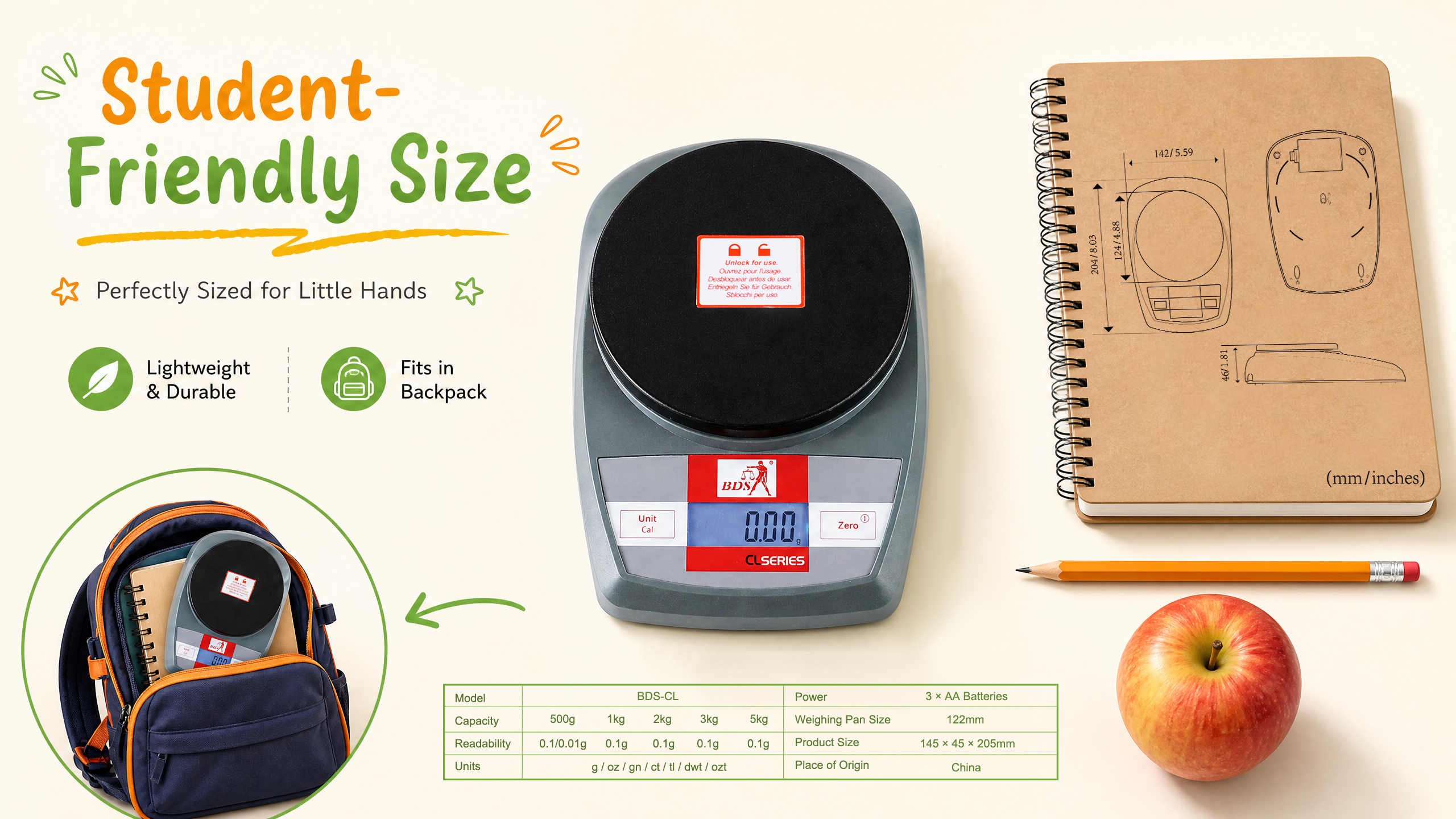
The BDS-CL teaching balance series offers 0.01g readability for the 500g model and 0.1g for 1kg and above models — a precision range validated by years of classroom use to fully cover K-12 science curriculum needs.
2. Usage Scenario Shapes the Design
Lab balances sit on fixed benches in stable environments, operated by trained lab personnel — their design philosophy is "precision first."
Teaching balances face much rougher conditions: students carry them from storage cabinets to classrooms, pull them out of backpacks, set them on desks covered with pencil shavings and water cups, and move them between classes throughout the day. This demands key design compromises specific to education:
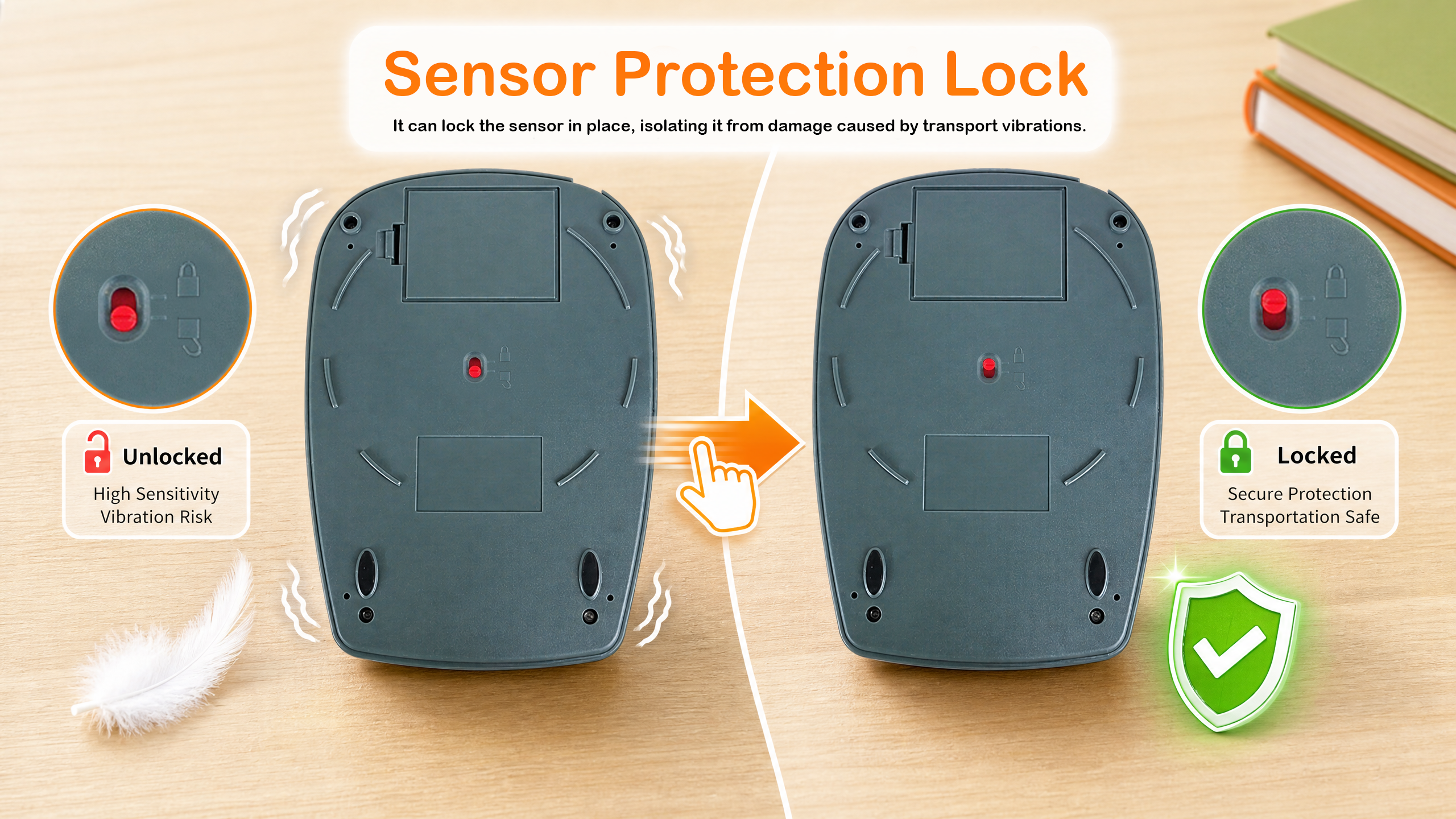
Transport vibration protection: Precision load sensors are easily displaced or damaged by shipping vibrations. Teaching balances must include a sensor lock mechanism — a bottom switch that mechanically locks the sensor when not in use, isolating it from transport damage. The BDS-CL's Sensor Protection Lock works exactly this way: unlocked mode gives full sensitivity for weighing; locked mode mechanically secures the sensor so it can be tossed into a backpack without harm.
Compact and portable: Teaching balances need to go where students go. The CL series measures just 145×45×205mm, runs on 3 AA batteries with no power cord required — usable on a classroom desk, by a window, or even outdoors during field observation lessons.
3. Operation Complexity Matches the User
Lab balances have many buttons, deep menus, and require specialized training — calibration modes, unit switching, data output, draft shield operation; a newcomer simply can't figure it out.
Students have neither the time nor patience for complex menus. The teaching balance design principle is: turn on and go, three buttons total:
- Zero: One-touch tare, place container and reset to zero
- Unit/Cal: One-touch unit switch (g/oz/ct and 8 units total), long-press for calibration
- Instant operation: No leveling required, no draft shield, no warm-up time
This isn't "simplified features" — it's feature pruning for the teaching scenario — keeping only what students actually need, and removing everything they don't.
4. Maintenance Cost and Durability
Lab balances are delicate: they fear drops, moisture, and overload impacts — one wrong operation can mean a trip back to the factory, and repairs are expensive.
Teaching balances face "rough use": students might place an overweight item, spill liquid, or bump the corner of the desk. Therefore teaching balances need reinforced design in housing material, sensor overload protection, and button durability. The CL series uses wear-resistant engineering plastic housing, and its sensor offers 2-3x overload protection — even if a student accidentally places something too heavy, the sensor won't be damaged.
Conclusion: The Core Logic for Choosing
For K-12 science classes, student group experiments, and science outreach activities, a dedicated teaching balance is all you need — adequate precision, simple operation, rugged enough for classroom use, and affordable to replace if damaged. Laboratory-grade analytical balances are only necessary for university research or corporate R&D precision analysis.
The BDS-CL teaching balance series is designed around exactly this positioning: 0.01g~0.1g precision for classroom experiments, sensor protection lock for daily transport between classes, three buttons for zero learning curve, and AA battery power with no cord limitations. It's not a "cheaper lab balance" — it's a product redesigned from the ground up for education.