Static Interference on Electronic Balances in Dry Weather
Recently, the climate is dry and the air humidity is low. Many customers report that after putting samples on the electronic balance, the reading rises slowly and steadily in one direction and fails to stabilize for a long time. This is most likely caused by static interference instead of balance failure.

High-precision electronic balances, analytical balances and semi-micro balances are very sensitive to static electricity. Static charges easily accumulate on plastic weighing boats, plastic containers, glassware and powder samples when rubbing or separating in dry environments. The attractive force from static electricity overlays the weighing signal, leading to slow upward drift of readings, poor repeatability and unstable zero point. This issue is especially obvious for high-precision models with 0.1 mg and 0.001 g readability.
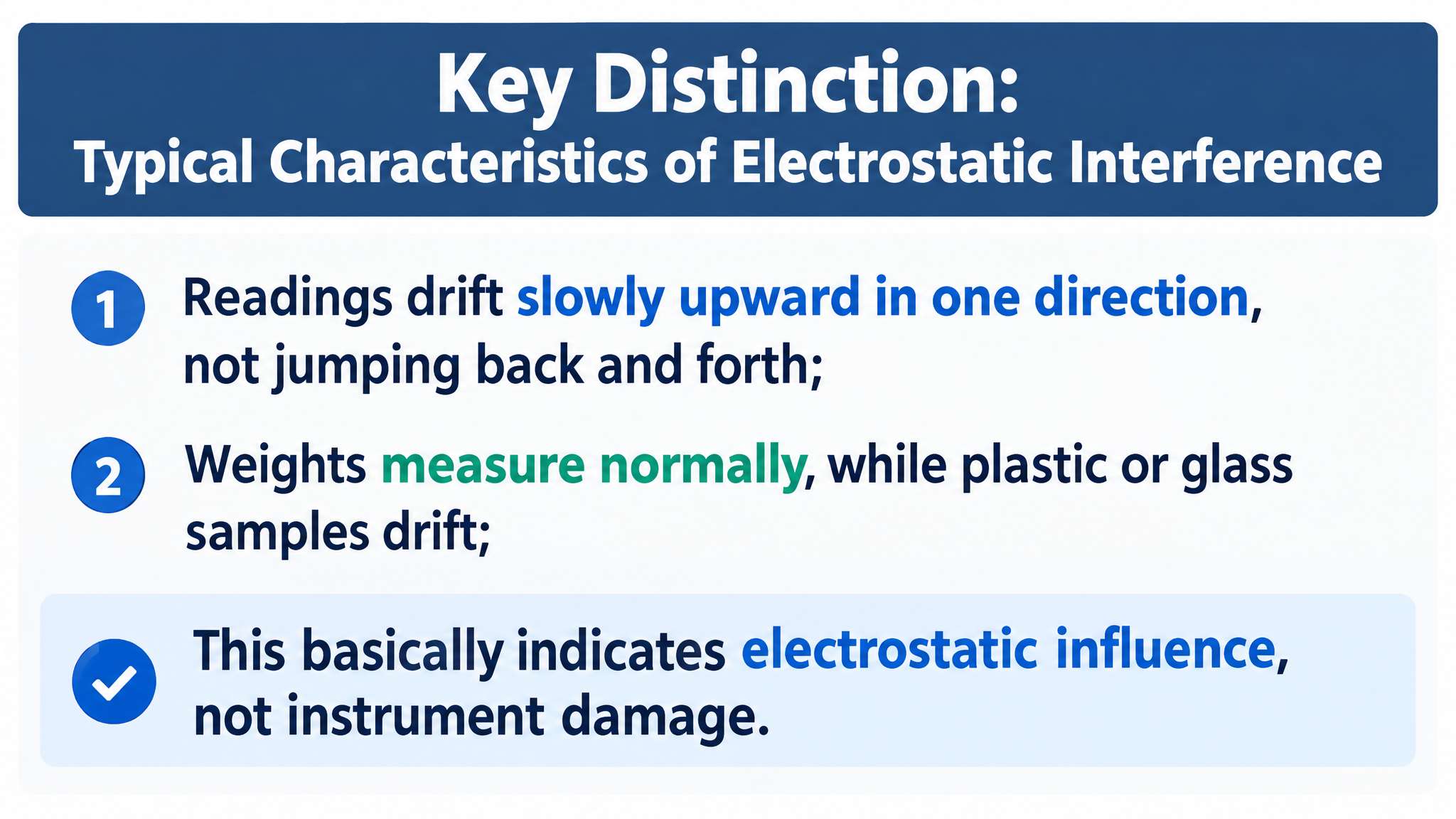
Key point for identification: Typical characteristics of static interference — readings rise slowly in one direction rather than jumping randomly. If the balance works well with standard weights but drifts when weighing samples in plastic or glass containers, it is basically static interference and the instrument itself is not damaged.
一. Quick Check and Solutions (In order of priority)
1. Control ambient humidity (first choice)
Keep the relative humidity of the weighing room at 45%–60%. Static electricity easily accumulates when humidity is below 45%. Use a humidifier if necessary. Avoid direct air conditioning airflow blowing onto the balance and keep the environment from staying dry.
2. Reliable grounding
Make sure the grounding terminal of the balance is well grounded. Good grounding can quickly discharge static charge accumulated on the balance housing and draft shield.
3. Replace weighing containers
Metal weighing dishes are preferred. Minimize the use of disposable plastic weighing boats and plastic centrifuge tubes. Do not rub the inner wall of containers repeatedly to avoid static generation. Glass vessels can also carry static charge and need static elimination before use.
4. Simple static elimination with damp cloth
Wipe your hands, the inner wall of the glass draft shield, stainless steel weighing pan and plastic weighing pan with a clean slightly damp cloth to release static charge on the surface by raising surface humidity. ⚠️ Important: The cloth must not drip water, to prevent water from seeping into the balance and damaging circuits and sensors. Wait for a while before weighing after wiping.
5. Standard operating practices
Do not rub weighing containers repeatedly with dry gloves. Let samples and containers stay in the weighing room for temperature stabilization in advance to reduce static generation. Keep the draft shield door closed and avoid rapid movement of personnel nearby.
6. Recalibration
Recalibrate the balance after static is removed and the environment becomes stable to ensure weighing accuracy.
二. When to contact our after-sales support?

If the reading still drifts continuously and remains unstable when testing with standard weights after taking all the above anti-static measures, there may be hardware or sensor faults of the balance. You can contact our technical support for inspection.
Reading drift caused by static electricity in dry weather is not a product quality issue. Stable weighing can be restored by proper environmental control.
Conclusion
High-precision weighing is a systematic work. Besides the instrument itself, temperature, humidity, static electricity, airflow and vibration all affect weighing results. We recommend customers monitor lab humidity regularly and take anti-static precautions in advance to guarantee accurate data for quality inspection, R&D and batching.
Please feel free to contact us if you have questions about grounding, static elimination operation or balance maintenance & calibration.